
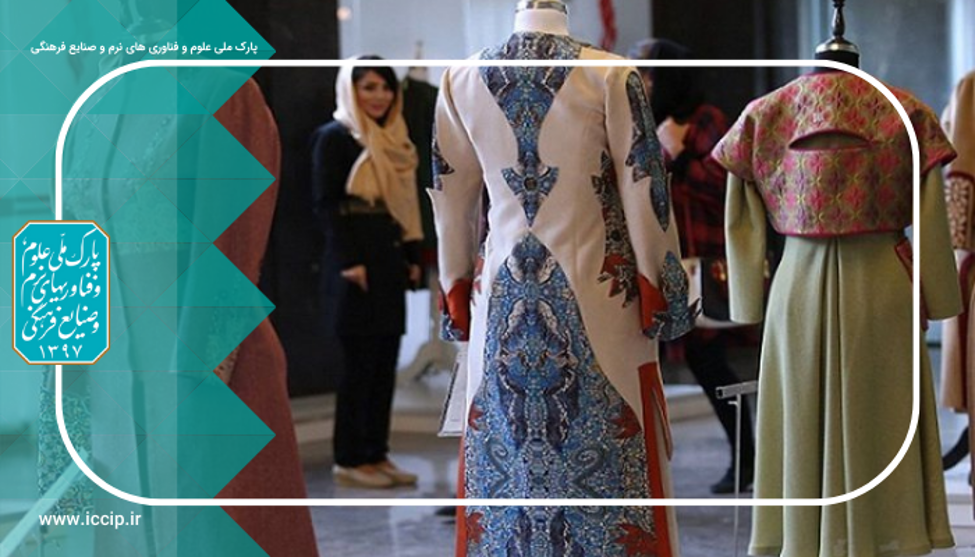
One of the creative companies located in the Soft Technologies and Cultural Industries Park, is specialized in the field of sustainable fashion in order to develop sustainably, protect the environment and resources, develop economically, and pay attention to the community. “Hanas” is one of the most important projects of this complex, which focuses on producing 11 product groups using fabric waste and plays an effective role in saving hidden water, reducing carbon emissions, and promoting a circular economy.
Khatoon Shahbazi, CEO of “Chia Mod” Institute and Secretary of the BRICS Committee in Iran, referring to the activity of this complex in the field of creative fashion and sustainable fashion, said: This institute, as a creative company that works in the field of facilitation, development of creative businesses, and cultural employment in the field of fashion. Our field of work is specifically focused on identity, creativity and design. In recent years, we have held the first Iranian fashion festival in the private sector and small businesses, titled “Cpal,” in which more than 2,000 creative Iranian designers participated. The festival provided opportunities for training, facilitation, branding and sales space for activists in this field; this event has become a creative trend in Iranian fashion over the past decade. We have been working professionally in the field of sustainable fashion for about five years, and the main focus of our work and goals is sustainable development, environmental and resource conservation, economic development and attention to society. The “Henaas” project is one of our most important projects in this field, which focuses on producing 11 product groups using fabric waste and plays an effective role in saving hidden water, reducing carbon emissions, and promoting a circular economy. He continued: “The Hanas project is the first fashion and sustainable development project in Iran to receive the Social Innovation Award, and its field of activity is defined within the framework of social innovation and social entrepreneurship. This project has the capacity to create sustainable employment for different groups, from university graduates to active workers at different levels of production.
“Quartet Embroidery; A Work of Art from the Seljuk Era
The CEO of Chia Mod Institute, referring to the international achievements of this project, said: The Hanas project reached the final stage of the BRICS event and gained the opportunity to be present in Africa to attract capital, although for various reasons we were unable to take advantage of this opportunity. Currently, this project is on the path to attracting investors to develop sustainable employment, especially for underprivileged women.
Emphasizing the difference between sustainable fashion and Chehel Tekke Douzi, Shahbazi explained: The history of Chehel Tekke Douzi in Iran dates back to the Seljuk era, but simply putting fabrics together does not necessarily constitute sustainable fashion. Sustainable fashion has a specific methodology, an implementation framework, and a deep connection with the goals of sustainable development and the circular economy. Many of the activities that are introduced today as sustainable fashion are merely artistic and creative works and have no connection to real sustainability. The Henas project has been nominated by the World Intellectual Property Organization (WIPO) with the approval of the four Sustainable Development Goals and is the only case study that the Hiroshima University of Peace and Sustainability in Japan has introduced as a comprehensive example. National and international awards in the field of social innovation and social entrepreneurship have also confirmed the verification of this project as the first sustainable fashion and development project in Iran.
Regarding the employment generation of this project, Shahbazi said: Currently, the Henas project is being implemented on a small scale and in the form of a 10-person workshop, and attracting investors is a serious necessity for its development and scale-up.
Iran’s Fashion Industry Has a Bright Future
Over the past decade, despite the difficulties, Iranian fashion has followed its path in a vibrant and dynamic manner. Our main hope is for the new generation of creative designers, and I believe that if this generation enters the field with the same level of effort, collective achievements will be multiplied. I see the 10-year vision of Iranian fashion as very bright, first-class, and world-class.” we can also transfer our experiences to grow new members and create successful work models. In my opinion, the park is a valuable place with great potential, and I hope we can make more use of these capacities

No comment